













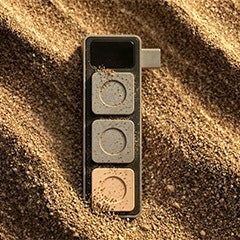
dune-5
Context-aware Mac keypad to automate workflows + meetings
Dune: The 3-Key Mac Keypad That Adapts to Any App
The productivity hardware market has a well-documented complacency problem. Stream Deck defined the category, sold the dream of a programmable button grid, and then mostly watched as users filled those grids with shortcuts they’d trigger twice a month before forgetting the profile management interface existed. Physical macro keypads haven’t changed their core pitch in years.
Dune is trying something different.
The product is a three-key physical keypad for Mac. Just three keys.
That constraint isn’t a compromise. It’s the argument. Dune’s central claim is context-awareness: the device reads whichever application is running in the foreground and reassigns all three keys automatically, in real time, without any manual profile-switching. Open VS Code and the keys serve one function. Flip to Zoom and they do something else. Switch to Claude running an agent workflow and the mapping changes again. No configuration menus. No profile toggle. The hardware just follows the software.
According to the product listing, it’s “built for developers who live in GitHub, VS Code, Claude, Openclaw, and for anyone running AI agents or in back to back meetings,” with specific support extending to Zoom, Teams, and Google Meet. The listing describes it as a device that “Automates workflows and meetings,” which is a fairly expansive claim for something with three buttons and no screen.
“The context-aware part is the actual story here,” Garo Sarkissian, CEO and founder of Dune Labs, said in the product launch materials.
He’s right that it’s what separates Dune from the commodity end of this market. But the claim deserves scrutiny before anyone reaches for a credit card.
Sarkissian’s background, according to his Crunchbase profile, covers more than 30 years in technology, mergers and acquisitions, and corporate development. That’s not where most hardware founders come from. The typical trajectory in physical product work runs through electrical engineering or industrial design, not strategy and finance. Whether Sarkissian’s background sharpens the product’s enterprise positioning or reveals something about where the real investment went, relative to the actual firmware, isn’t clear from the outside yet. It’s worth watching.
The three-key ceiling is where Dune’s case gets interesting.
A Stream Deck gives you 15 buttons on the standard model, 32 on the XL. What actually happens with those grids, for most users, is that they load up a bunch of shortcuts the first weekend, feel briefly productive, and then never touch the profile manager again because switching contexts manually is annoying enough to cancel out the efficiency gain. The cognitive overhead of maintaining a 32-button grid isn’t zero. The promise of the macro keypad is faster access to frequent actions. The reality is that the management layer eats back a portion of that benefit.
Dune is making a specific bet: three keys that are always correct for your current context beat 30 keys you have to actively manage. That’s not a novel idea in UX thinking, but it’s rarely been executed in physical hardware at this price point. The device lists at $150, which positions it above impulse-buy territory and squarely in the “justify this to yourself or your employer” range.
The market context matters here. The global business productivity software market reached $62.5 billion in 2024, according to a Yahoo Finance analysis of industry research, with a projected compound annual growth rate of 14.8% from that baseline. The productivity apps segment specifically was sitting at roughly $14.46 billion in 2026, according to Fortune Business Insights, with projections extending to $30.85 billion by 2034. That’s a lot of room for adjacent hardware to ride the tide.
The broader research on knowledge worker productivity points to a workforce increasingly fragmented across applications: developers context-switching between code editors, AI assistants, communication tools, and project trackers within the span of a single hour. The pain point Dune is addressing is real. Whether a three-key pad solves it or merely gestures at solving it depends entirely on how well the context-switching firmware actually works in practice.
Here’s where I’ll sit with genuine uncertainty rather than fake confidence.
The hardware concept is coherent. Three keys with automatic context remapping is a cleaner value proposition than anything Stream Deck has shipped, because Stream Deck’s actual product is the software ecosystem and the hardware is just access. Dune is inverting that: the hardware constraint is intentional, and the software behavior is supposed to be invisible. If the firmware works reliably across the 100-plus applications a typical developer touches in a week, that’s a genuinely useful device. If it’s solid across 4 flagship apps and patchy elsewhere, it’s a $150 accessory for VS Code power users.
Sarkissian’s M&A background could cut either way on that question. Enterprise-grade thinking about knowledge worker workflows is valuable precisely because most hardware people don’t have it. Someone who’s spent 30 years watching how companies actually integrate software into daily work might understand the context-switching problem more clearly than an engineer who optimized the PCB. On the other hand, the firmware that detects foreground applications and maps key behavior reliably is a non-trivial engineering problem, and finance backgrounds don’t write firmware.
The “just remap your keyboard” crowd will make their presence known in any comment section this product touches. It’s the standard counter-argument to any macro hardware: keyboards are programmable, software like Karabiner-Elements does this for free, why pay $150 for three buttons. That argument has real force if you’re a power user who already lives in configuration files. It has less force for the developer who doesn’t want to maintain a keybinding config alongside everything else they’re already maintaining, or for the person grinding through 29 video calls a week on Zoom and Teams who just wants mute to be a physical button that’s always mute regardless of which meeting app is open.
That second person is the actual target customer. Dune seems to know this.
The Product Hunt listing’s description of the intended user, someone living in GitHub, VS Code, Claude, and Openclaw while also surviving back-to-back meetings on three different video platforms, is a fairly specific profile. It’s not a hobbyist. It’s a developer or technical knowledge worker in 2026 whose toolkit has expanded faster than any single keyboard shortcut scheme can track. The number of applications a senior engineer or product manager touches daily has grown substantially. The shortcuts those applications each want you to learn have not gotten any more consistent.
Three keys that follow you through that chaos is a defensible product idea.
What I don’t know yet: how Dune Labs plans to build out and maintain the application-specific key mapping library over time, whether there’s a community layer where users can contribute or share mappings, and how the $150 price point holds up against the product’s actual stickiness once the novelty wears off. Hardware retention is notoriously hard to measure, and the Stream Deck comparison cuts in an uncomfortable direction here: a lot of Stream Decks are sitting in drawers.
The market trajectory from $14.46 billion in 2026 to a projected $30.85 billion in 2034 suggests the enterprise software and productivity hardware ecosystem will keep growing. Dune Labs is positioning early in what could be a significant wave of context-aware peripheral hardware, devices that don’t just provide input but respond to software state. If that category materializes the way the numbers suggest it might, being the product that defined the three-key context-aware form factor is worth something.
Sarkissian’s 552 connections on Crunchbase and his background in corporate development suggest Dune Labs won’t have trouble getting in front of enterprise buyers. The question is whether the product delivers enough at the individual user level to generate the kind of organic word-of-mouth that drives hardware adoption, because enterprise procurement alone doesn’t build a hardware brand.
“The context-aware part is the actual story here,” Sarkissian said. At $150, it had better be.